
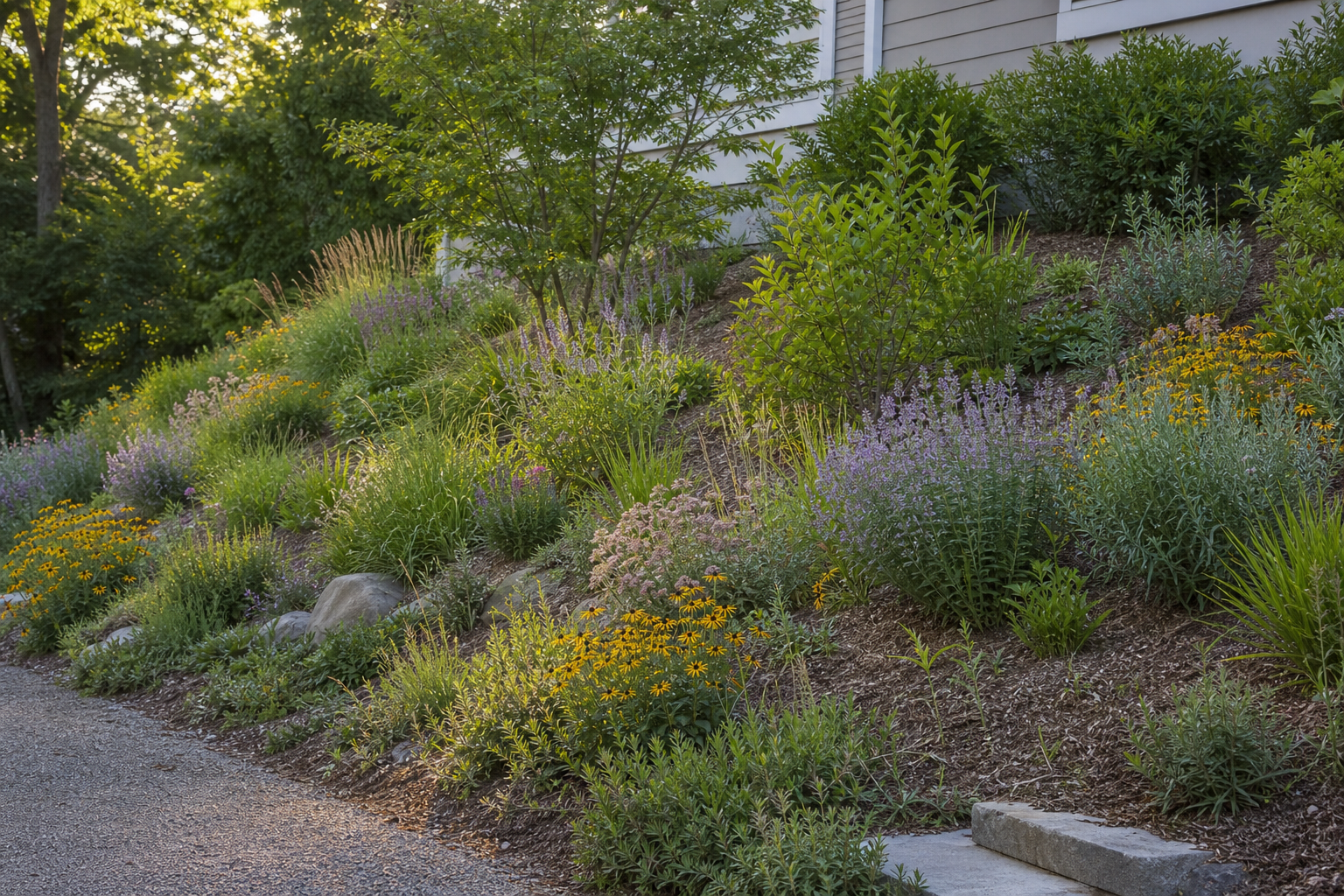
A slope is one of the hardest places to maintain lawn and one of the best places to use layered planting. Native plants can help slow runoff, cover bare soil, support habitat, and make an erosion-prone area easier to manage.
Key Takeaways
- Plant roots help hold soil better than bare mulch alone.
- Use a mix of ground covers, perennials, grasses, and shrubs.
- Start with erosion control while young plants establish.
- Avoid aggressive digging that loosens the slope further.
Quick Comparison
| Slope Need | Plant Role | Helpful Feature |
|---|---|---|
| Bare soil | Ground cover | Fast surface coverage |
| Runoff | Deep-rooted perennials | Slows and filters water |
| Structure | Shrubs | Anchors planting zones |
| Habitat | Native flowers | Supports pollinators |
Stabilize first, beautify second
Before choosing flowers, make sure the slope is protected from bare-soil runoff. Mulch, erosion-control fabric made from biodegradable fibers, small check logs, or temporary straw can help while plants establish.
Use layered planting
A slope planted with only one species can fail in patches. A layered mix is more resilient: low ground covers near edges, clumping perennials through the middle, and shrubs where structure is needed.
For smaller edges, see Native Ground Covers for Small Yards and Garden Edges.
Choose plants for moisture pattern
The top of a slope often dries quickly while the bottom may collect water. Match plants to those micro-sites instead of treating the whole slope as one condition.
Plant in staggered groups
Rows can channel water downhill. Staggered groups interrupt flow and look more natural. Leave enough space for mature size, then mulch carefully between plants until they fill in.
A Simple Planting Pattern for Slopes
For a small slope, think in staggered bands. Put tougher ground covers near the lower edge, clumping perennials through the middle, and shrubs or deeper-rooted plants where the slope needs structure. This breaks up water movement better than straight rows.
- Plant in offset groups rather than lines.
- Mulch between new plants while roots establish.
- Keep foot traffic off wet soil.
- Water slowly so irrigation does not run downhill.
When a Slope Needs More Than Plants
Plants help many mild slopes, but they are not a structural fix for severe erosion, collapsing soil, or water cutting channels through the yard. If soil is moving after every storm, solve the water path and grade first, then plant into the stabilized area.
FAQ
Are native plants good for erosion control?
They can be very useful because roots help hold soil and foliage slows rain impact. Establishment protection still matters.
Should I mulch a slope?
Yes, but use mulch carefully so it does not wash away. Pair mulch with plants, edging, or small check barriers.
Can I plant a slope without terracing?
Often yes for mild slopes. Steeper slopes may need professional grading, terracing, or erosion-control planning.
Conclusion
A slope does not need to stay as struggling lawn. With native ground covers, perennials, shrubs, and careful establishment, it can become a lower-maintenance planted area that protects soil and supports habitat.
Image Credits
- Featured image generated for Renewable Gardening as a custom editorial image for Native Plants for Slopes: Low-Maintenance Ideas for Erosion-Prone Yards (media ID 568).